Introduction:
- One way to help you get ahead financially and achieve your long-term goals is to build a portfolio of quality investments that work for you.
- To do this, you create a strategy and plan your investments in a way that earns you the highest return
- with a level of risk that suits you. Passive and active investing are two main investment strategies for investing your money.
- Both work for you, but they differ in their approach and purpose.
- So, let’s take a look at some of these ideas.
- Passive vs. Active Passive investing can also be considered.
Passive vs. Active:
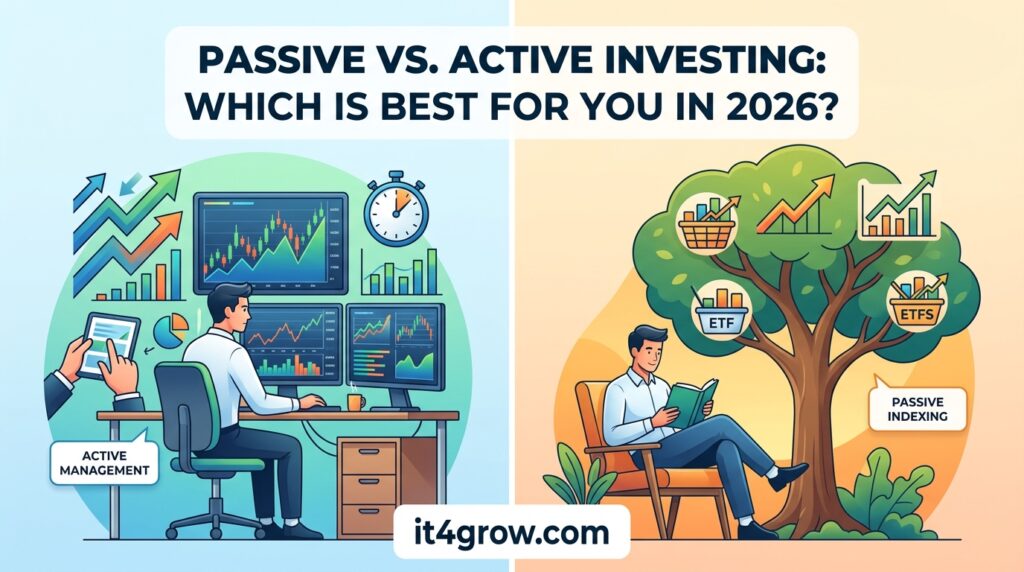
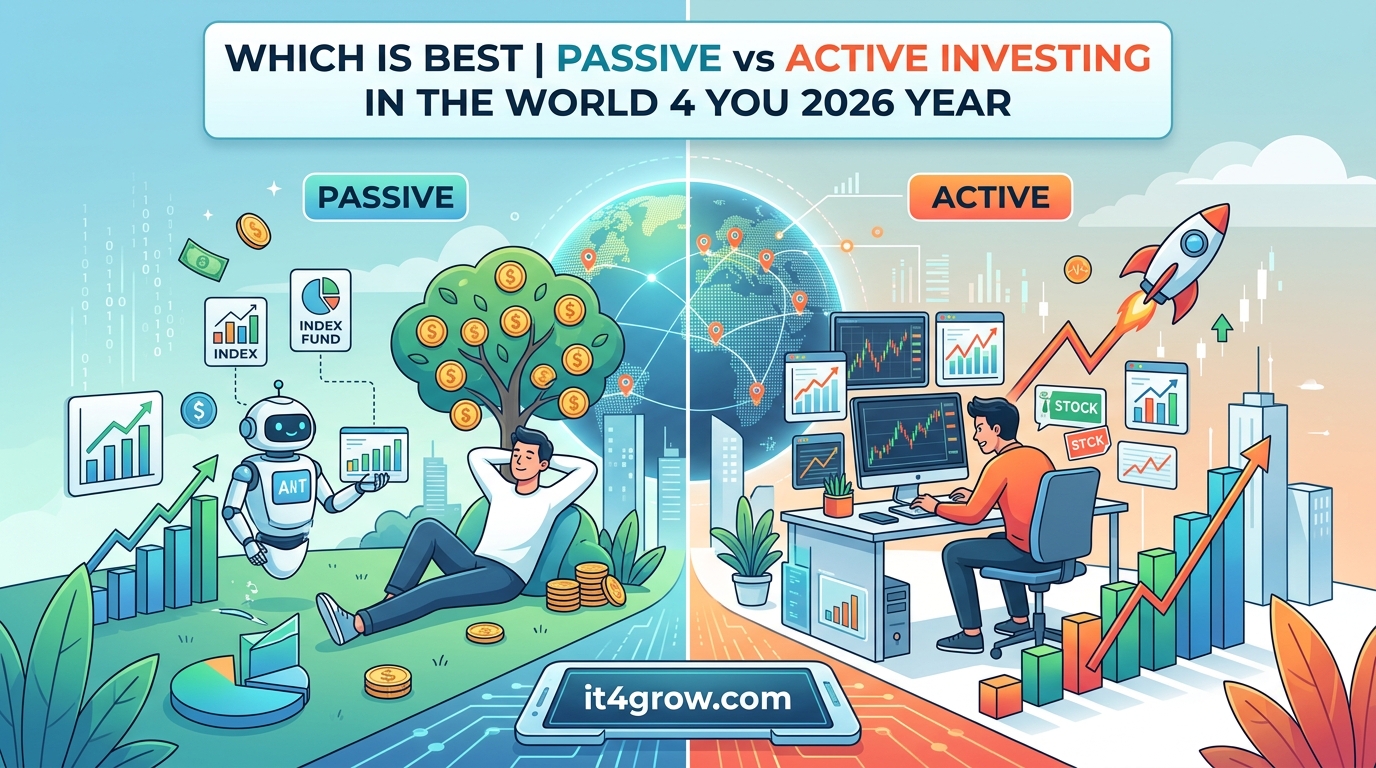
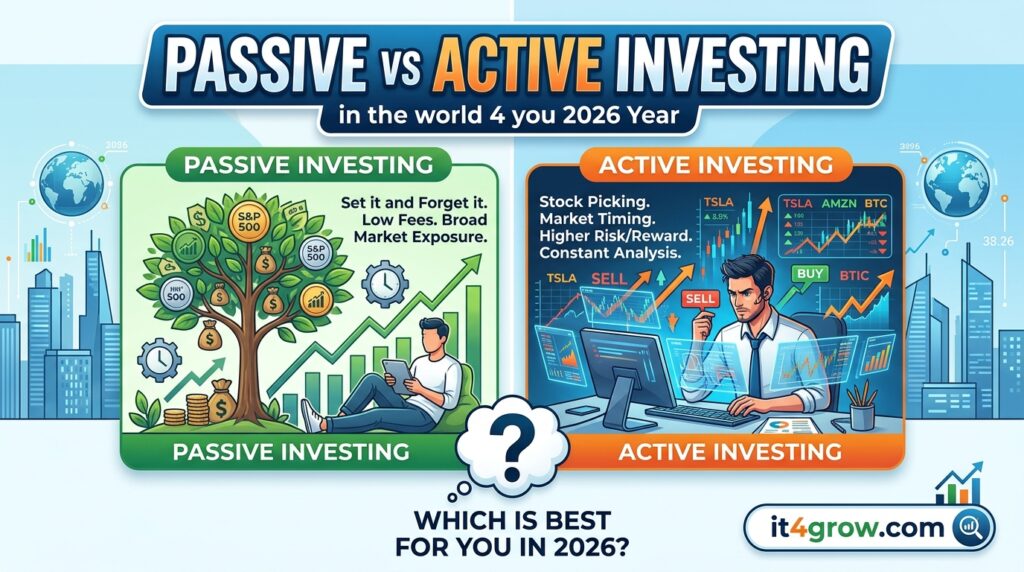
- The “hands-off” approach; it’s about passively buying and holding investments in the market.
- An asset for the long term.
- You choose a stock, bond, or other asset, and you hold it through various market conditions.
For a long time. - These investors don’t just try to beat the market to make ends meet.
- While active investing focuses on individual assets, passive investing typically involves investing through index funds or exchange-traded funds (ETFs).
- Think of it this way: individual stocks are like the meat, milk, batteries, soap, and grains you buy at the
- grocery store.
- Once you’ve filled your cart, that’s all your groceries.
- In investing terms, you can call your entire grocery cart a grocery index.
Similarly, when you buy the S&P 500, you’ve diversified your portfolio into the stocks of the 500 largest companies. - On the other hand, actively investing in the market means that you trade with it frequently.
The goal is to outperform the market. - Active investors regularly select trading positions and buy and sell stocks and other assets on a continuous basis.
- Hedge fund managers are an example of active investors.
- They monitor the market and actively trade based on what they see.
- Hearing in the financial industry.
- They use high-level market analysis, experience, and expertise to choose the best time to sell.
Or buy individual assets to profit from short-term price fluctuations or market movements.
Timing|Fees:
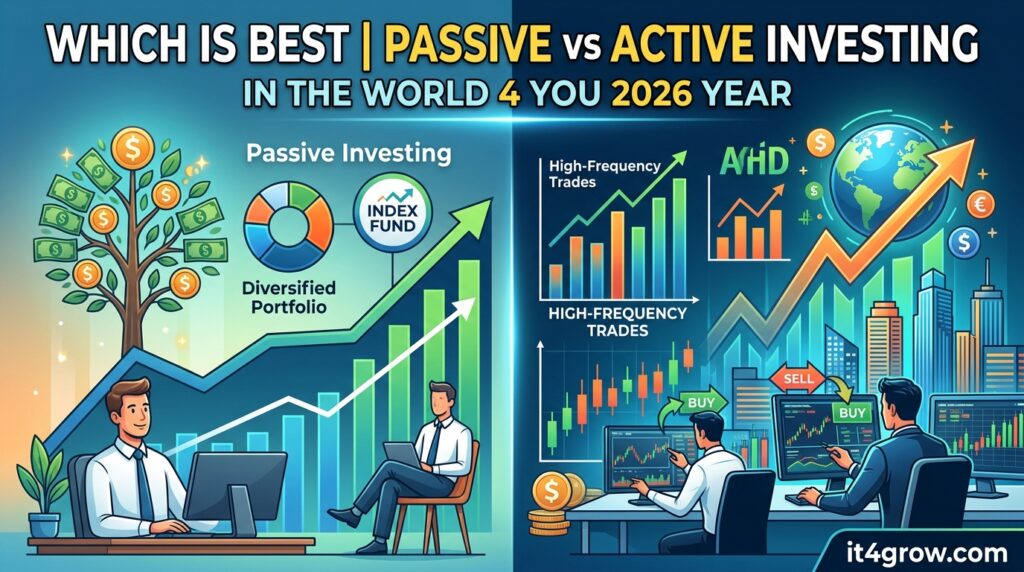
- Fees Passive investing does not require daily
- Attention since it’s a hands-off, set-and-forget approach to investing.
- It’s also a lower-cost investing strategy.
- Since passive investors do not enter and exit high volumes of trades, the associated
- cost of trading is also lower for the individual investor.
- Passively invested funds also attract lower expense charges as very little research and
- Upkeep is needed.
- Their expense charge could be as low as 0.06% on passive mutual funds and 0.18% on passive
- ETFs, on average.
- On the other hand, active investing attracts higher fees.
- They may need to pay higher management fees for actively managed mutual funds or engage
- in frequent trading, which can incur more transaction costs.
- Don’t forget the additional cost of the research, analysis, and monitoring tools that
- are generally used.
- Expense charges alone could reach 0.71%, on average.
- These percentages may appear insignificant, but the difference between 0.18% and 0.71% could mean thousands removed from your return in retirement.
- Risk Passive investing is usually less risky, as Risk this approach to investing is more fund-focused.
- When you invest passively, your money is spread across hundreds, if not thousands, of stocks
- and bonds.
- The good thing about this is that your portfolio is easily diversified.
- This comes with a decreased probability that the investment is going to drain your portfolio.
- Since your portfolio is exposed to a lot of stocks, the probability that all individual
- stocks are going to turn out badly is low.
- So even if a few individual stocks return negative, chances are other individual stocks within the index may balance it out.
- So, while this strategy may not generate exceptionally high returns, it also helps mitigate the risk
- of underperforming the market.
- Active investing comes with both the potential for higher returns and higher risks.
- Since active investors aim to outperform the market, their success depends on their ability to make accurate investment decisions.
- But a lack of appropriate diversification and one bad stock could potentially wipe out entire gains accumulated over years or investors can be exposed to the risk of underperformance, as active managers may not consistently beat the market over the long term.
- The point is that active investing comes with increased risk.
- Even though, as an active investor, when you’re right, you stand to win big, one wrong investment
- can drag down the performance of your entire portfolio with significant losses. Transparency Transparency Using the passive investing approach, what what you see is what you get.
- Passive investing usually has increased transparency.
- Because passive investing usually attempts to replicate specific stock market indexes,
- it will rarely hold investments that are not part of its named index. This means that if the specific stock does well, then you’re sure its index will too perform well, but the opposite is also true.
- Now with active investing, this level of transparency is not always provided.
- You don’t get a mirror to compare your investments because much of your investment outcome is at the discretion of the investor.
Average Returns:
- Average Returns Passive investing almost always provides a higher average return in the long run.
- According to the latest S&P Indices Versus Active (SPIVA) report, over 90% of passively Invested index
- funds of all sizes outperformed their active counterparts over 20 years.
- One possible explanation is that active investing exposes the investor to trend-chasing.
- They are more likely to be influenced by “in the moment” market trends.
- Consider the investors who followed the at-home workout trend and purchased Peloton (PTON)
at a high of $146 during the pandemic in 2021. - As of the creation of this video in early 2023, the stock is below $10.
- As you can see from this example, the biggest issue with trend-chasing is that you can’t
tell if a stock can still grow or if you’re just at the tip of the trend.
Advantages / Disadvantages Despite all these advantages passive investing:
Advantages vs Disadvantages:
- has, active investing also has an edge over passive investing.
- First, a volatile market is flexible if you choose the active investing approach.
- In a volatile market, an active investor could move to a more defensive position, such as turning volatile assets into cash or bonds to protect his portfolio from further depreciation.
- With this capacity to respond to real-time market conditions, active investors may be able to outperform certain market benchmarks, like the S&P 500, in the short term.
- Because passive investing is typically done with a long-term perspective, it does not
have an exit strategy in the event of a severe market downturn. - You could argue that the stock market has historically recovered from every correction,
but there’s no guarantee that the corrections will be swift. - This is why passive investors should periodically review and rebalance their asset allocation.
When a passive investor does this correctly, his portfolio becomes more conservative - He approaches the end of his investing timeline.
- He recovers much more quickly from a market downturn this way.
- Second, with active investing, you have more trading options.
- As an active investor, you can generate windfalls by shorting stocks or hedging options, which
- increases your chances of beating the market indices in the short term.
- These trading techniques, however, have the potential to increase the risks and costs
associated with active investing. - And they are best left to seasoned investors and professionals.
- Now, there is more to consider than the high-level picture we’ve shown to answer the question
of whether to invest actively or passively. - in some market conditions, active investing could be more beneficial to investors than
passive investing. - For example, active investing may produce better results in a volatile or weakening
economic market. - Passive investors may benefit more when certain market indices pick up momentum and increase
Passive vs Active Investing | Which Is Best For You
- in value over time.
- However, in either market condition, there are no guarantees.
And, because market conditions change all the time, you’ll need to be highly aware of it
decide whether to invest passively or actively. - Passive investing can be a good option for individual investors, particularly those with
limited money to invest. - The last thing you want is to waste money on high-cost trading fees that result in lower
long-term returns. - Some of you may already be making passive investments as a personal investor through
your employer-sponsored retirement plan, such as a 401(k). - If you don’t already have one, a good 401(k) is the most convenient way to get started.
So what’s the answer to which is better, passive or active investing? - As with many other decisions you’ll have to make as an investor, it all comes down to
your personal goals and priorities. - But hopefully we’ve given you a few things to think about.
Thanks so much for watching. - If you haven’t already, please like and subscribe and tell us below which strategy you use for
your investing.